Pick up a leaf and it can look deceptively simple.
A blade. A stalk. Some veins.
Look at a few different native trees, however, and an extraordinary variety begins to appear.
Some leaves are single. Others are divided into many leaflets.
Some have smooth edges. Others are sharply toothed, gently wavy or deeply lobed.
Some emerge opposite one another on the twig. Others alternate from side to side. Some develop in a spiral around the stem.
And hidden within many plant spirals is one of the best-known mathematical patterns in nature: the golden angle.
Trees are therefore not only useful for timber, shelter, wildlife, carbon and landscape.
They are also rather beautiful pieces of geometry.
Start with the leaf
Leaves are one of the easiest ways to begin identifying a tree.
Botanists look at several characteristics:
- whether the leaf is simple or compound;
- its overall shape;
- the pattern of its veins;
- its edge, or margin;
- the way it joins the twig; and
- the arrangement of successive leaves along the shoot.
Taken together, those features can narrow an unknown tree down surprisingly quickly.
The Woodland Trust's guide to identifying trees starts with exactly this, dividing the leaves of broadleaved trees into two basic types: simple and compound.
Simple leaves
A simple leaf has one continuous leaf blade, which is not divided right to the central vein.
That does not mean the edge has to be simple.
A small-leaved lime, for example, has a simple, heart-shaped leaf.
Birches also have simple leaves.
A hawthorn leaf is deeply lobed, but it is still one leaf rather than several separate leaflets.
That distinction catches people out surprisingly often. The Woodland Trust specifically warns against mistaking lobed simple leaves — hawthorn, field maple and sycamore among them — for compound ones.
Compound leaves
A compound leaf is divided into separate leaflets.
Ash is one of the most recognisable British examples.
Its leaf is pinnately compound: pairs of leaflets are arranged along a central stalk, with a single leaflet at the end, creating something rather like a feather.
Rowan and elder have the same broad construction — though, as we will see, they differ in how the whole leaves are arranged on the twig.
This matters for identification, because what first looks like a small leaf may be just one leaflet within a much larger leaf.
A useful tip from the Herts and Middlesex Wildlife Trust's summer tree key: look for a bud. Buds form where a whole leaf meets the twig, never at the base of an individual leaflet.
The distinction is quite elegant once you start seeing it.
The edge tells another story
Botanists call the edge of a leaf its margin.
Margins take many forms.
A smooth edge with no teeth is described as entire. Dogwood is a good native example: its oval leaves have smooth sides and characteristic curving veins.
Other leaves are toothed, or serrated.
Hornbeam is a good example: its leaves have finely toothed edges — in fact doubly toothed, with smaller teeth on the larger ones.
Beech can look superficially similar, but its leaf edge is wavy rather than toothed. That single difference is one of the quickest ways to tell the two apart.
Hawthorn introduces another form altogether, with deep lobes cutting at least halfway to the midrib.
Oak is lobed too, but its rounded lobes have smooth edges — a reminder that "lobed" and "entire" describe different things and can occur on the same leaf.
These differences are not decorative details.
They are part of the architecture of the plant and useful clues to its identity.
Then look at the twig
The really interesting mathematics begins when we stop looking at one leaf and start looking at how several leaves are arranged.
This is called phyllotaxis — the arrangement of leaves, or other organs such as buds, scales and florets, around a plant stem.
There is no single arrangement used by all trees.
Several common patterns occur.
Opposite
Two leaves or buds occur at the same point, directly opposite each other.
Ash is a very useful native example: its black buds sit in opposite pairs.
Spindle, dogwood and elder also have opposite leaves.
Alternate
One leaf occurs at each point on the twig, with the next appearing further along on another side.
Hazel, hornbeam, beech, small-leaved lime and birch are familiar examples.
On hornbeam, beech and lime the leaves typically lie in two flat rows, one either side of the twig — an arrangement botanists call two-ranked (distichous).
Rowan is a nice test of observation: its leaves are alternate, but the Woodland Trust notes that at a quick glance they can look opposite.
Spiral
Successive leaves or buds rotate progressively around the stem rather than settling into two rows.
Oak is the classic native example. Botanical descriptions of the oak genus record its leaves as spirally arranged, and in winter its buds gather in clusters at the shoot tips.
Hawthorn leaves also follow a spiral along its long shoots, while bunching into clusters on its short spur shoots.
Strictly, botanists treat spiral as a form of alternate arrangement — each point on the stem still carries one leaf. The difference is how far round the stem each new leaf sits.
These patterns become particularly useful in winter.
Once deciduous leaves have fallen, the arrangement of buds along the twig is one of the main clues that can identify the species.
Leaf features at a glance
| Feature | What to look for | Native examples |
|---|---|---|
| Simple leaf | One continuous blade, even if lobed | Small-leaved lime, birch, hornbeam, beech, hazel, hawthorn, oak |
| Pinnately compound leaf | Separate leaflets along a central stalk | Ash, rowan, elder |
| Entire (smooth) margin | No teeth along the edge | Dogwood; the lobes of oak |
| Serrated (toothed) margin | Small teeth along the edge | Hornbeam, hazel, birch, small-leaved lime, spindle, blackthorn |
| Wavy margin | Edge undulates without distinct teeth | Beech |
| Lobed margin | Deep indentations, still one leaf | Hawthorn, oak |
| Opposite arrangement | Leaves or buds in pairs at the same point | Ash, spindle, dogwood, elder |
| Alternate arrangement | One leaf per point, changing side | Hazel, hornbeam, beech, small-leaved lime, birch, blackthorn, rowan |
| Spiral arrangement | Each leaf further round the stem | Oak; hawthorn on its long shoots |
Twelve native trees compared
| Tree | Leaf | Margin | On the twig |
|---|---|---|---|
| Ash (Fraxinus excelsior) | Pinnately compound, 3–6 pairs of leaflets plus one at the tip | Leaflets toothed | Opposite; black buds in pairs |
| Rowan (Sorbus aucuparia) | Pinnately compound, 5–8 pairs of leaflets plus one at the tip | Leaflets toothed | Alternate (can look opposite) |
| Small-leaved lime (Tilia cordata) | Simple, heart-shaped | Finely toothed | Alternate, two-ranked |
| Silver birch (Betula pendula) | Simple, roughly triangular | Doubly toothed | Alternate |
| Hornbeam (Carpinus betulus) | Simple, oval, with a pleated look | Finely (doubly) toothed | Alternate, two-ranked; buds pressed to the twig |
| Beech (Fagus sylvatica) | Simple, oval with a pointed tip | Wavy | Alternate, two-ranked; long pointed buds standing away from the twig |
| Hazel (Corylus avellana) | Simple, round to oval | Doubly toothed | Alternate |
| Blackthorn (Prunus spinosa) | Simple, oval | Toothed | Alternate; buds along the spines |
| Hawthorn (Crataegus monogyna) | Simple, 3–5 deep lobes | Lobed, toothed near the tip | Spiral on long shoots; clustered on spurs |
| English oak (Quercus robur) | Simple, deep rounded lobes | Lobed, smooth-edged | Spiral; buds clustered at the tips |
| Spindle (Euonymus europaeus) | Simple, oval | Finely toothed | Opposite |
| Dogwood (Cornus sanguinea) | Simple, oval with curving veins | Entire (smooth) | Opposite |
All twelve are native to Britain. Beech is considered native only in south-east England, though it is planted throughout the UK, and dogwood is mainly a plant of southern England's woodland edges and hedgerows. Leaves vary between individual trees, so treat these as typical features rather than fixed rules.
Where does the golden ratio enter?
Now we reach the fascinating bit.
In many plants with spiral phyllotaxis, successive developing leaves or other organs emerge at an average angle close to 137.5°.
This is known as the golden angle.
Plants do not perform this calculation, of course.
The pattern emerges through biological development at the growing tip — the shoot apical meristem — as new leaf primordia form.
Phyllotaxis has fascinated philosophers, mathematicians and natural scientists for centuries precisely because biological development can generate such strikingly regular numerical patterns.
Why 137.5 degrees?
Imagine placing leaves around a stem.
Put every new leaf exactly halfway round — 180° from the previous one — and the leaves line up in two rows, one directly above another.
Use a third of a turn and they line up in three rows. Other simple fractions of a turn eventually produce rows too.
The golden angle is unusual because it is not a simple fraction of a turn: it never settles into a whole-number pattern.
Successive leaves therefore keep appearing in different positions around the stem rather than repeatedly lining up with those below.
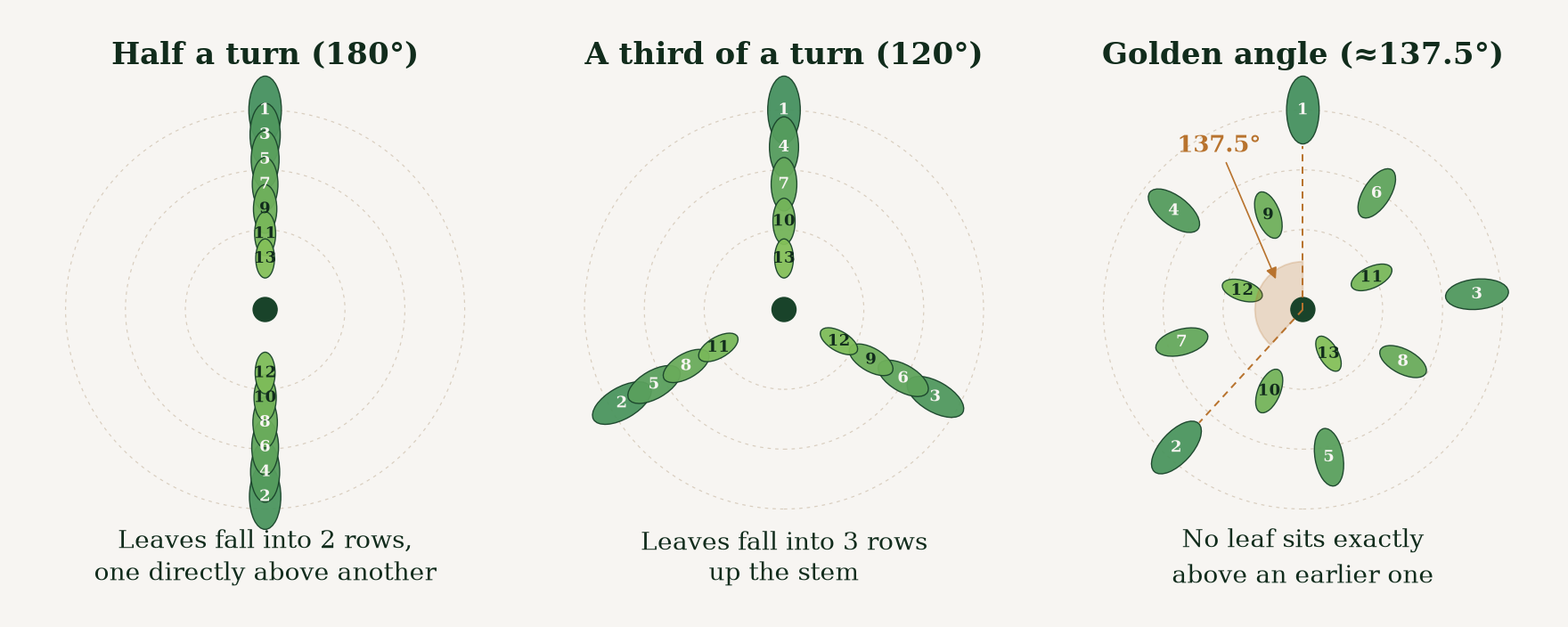
Looking down on a growing shoot tip: leaf 1 is the oldest and 13 the newest, nearest the tip. Each new leaf is placed a fixed fraction of a turn from the last. At half a turn or a third of a turn, leaves stack into rows; at the golden angle, they spread evenly around the stem.
The result can be a remarkably even distribution.
This geometry is associated with the famous spiral patterns seen particularly clearly in sunflower heads, pine cones and many other plant structures.
It also appears in leaf development.
But nature is untidier than a mathematics textbook.
Not every tree follows the golden angle
This is an important qualification.
The golden angle is common in spiral phyllotaxis.
It is not a universal law saying every plant places every leaf 137.5° from the previous one.
Some plants have opposite leaves, like ash.
Others form two-ranked rows, like beech and hornbeam, or whorls of three or more leaves at the same point.
Others follow different spiral fractions.
And the visible arrangement of mature leaves can differ from the initial arrangement at the growing tip as the stem elongates and leaf stalks twist towards the light.
Research into phyllotaxis therefore treats the golden angle as a remarkably widespread developmental pattern rather than a mysterious numerical rule imposed on all plants.
That distinction arguably makes the phenomenon more interesting, not less.
And then Fibonacci appears
The golden ratio has another famous mathematical companion: the Fibonacci sequence.
It begins:
1, 1, 2, 3, 5, 8, 13, 21, 34…
Each number is the sum of the two before it, and the ratio between neighbouring numbers gets ever closer to the golden ratio.
When plant organs form spiral arrangements associated with the golden angle, the visible families of spirals often correspond to consecutive Fibonacci numbers.
That is particularly obvious in tightly packed structures such as sunflower heads and cones.
In trees, the relationship shows up in the fractions botanists have used since the early nineteenth century to describe leaves around stems — a half, a third, two-fifths, three-eighths of a turn — whose numbers are themselves drawn from the Fibonacci sequence.
The mathematics and biology are related, but it is better to think of Fibonacci numbers as something that emerges from the geometry of growth than to imagine trees are somehow counting.
Why arrange leaves at all?
A tree has a practical problem.
Every leaf needs access to resources.
Leaves need light for photosynthesis.
They need connections to the plant's vascular system.
They need room to develop.
They must coexist with branches, buds and reproductive structures.
The developing shoot therefore needs an organised way to position each new organ.
Research points to interactions between plant hormones — particularly auxin, which accumulates at the sites where new leaves form — physical growth and the geometry of the shoot tip in producing phyllotactic patterns. Physicists have even reproduced Fibonacci spirals in laboratory experiments with no plant involved, simply by adding new elements that repel the ones already there.
Whether the golden angle also gives plants a measurable advantage — in capturing light, for example — is still argued over. It is safest to see it as a consequence of how shoots grow, rather than a design with one proven purpose.
What looks like mathematical decoration is therefore part of the mechanics of becoming a tree.
A useful way to learn British trees
This gives us a rather different method of tree identification.
Instead of asking only:
What shape is the leaf?
Try asking four questions.
1. Is it simple or compound?
One continuous blade, or several separate leaflets?
2. What is the margin?
Smooth, serrated, wavy or lobed?
3. How are the leaves or buds arranged?
Opposite, alternate, spiral or whorled?
4. What other clues agree?
Bark, buds, flowers, fruit, thorns, habitat and overall tree shape.
Identification becomes a process of assembling evidence rather than matching one leaf against a photograph.
Try it on a few familiar trees
Take ash.
Its leaves are pinnately compound, while its famously black buds occur in opposite pairs.
Now compare hornbeam.
Its leaves are simple with finely toothed margins.
Then beech.
Simple again, but with a wavy, untoothed margin.
A hawthorn gives us a deeply lobed simple leaf.
And an oak introduces another distinctive lobed leaf — this time with smooth edges — combined with a spiral arrangement and clustered buds.
Suddenly five trees that were simply "green leaves" become structurally very different organisms.
The mathematics is useful for children too
This makes an excellent bridge between subjects.
A tree can become a lesson in:
Biology — leaves, photosynthesis and plant growth.
Mathematics — angles, ratios, sequences and spirals.
Geography — habitats and landscapes.
Art — symmetry, pattern, form and natural design.
Environmental science — biodiversity, carbon and land management.
A class does not need sophisticated equipment.
A twig, several leaves, a ruler, a protractor, a camera and some curiosity are enough.
Pupils can compare:
- leaf length and width;
- number of leaflets;
- margin type;
- opposite versus alternate buds;
- branching patterns;
- symmetry;
- and the approximate rotation of leaves around stems.
The tree becomes both specimen and textbook. If your school is planting during National Tree Week, the new trees make a ready-made outdoor classroom — and our guides to planting a school hedge and young tree survival cover what happens next. Families can join in too by recording leaf and bud dates for the Woodland Trust's Nature's Calendar.
There is a practical farming connection too
Correct tree identification is not simply an academic exercise.
For farmers, landowners and advisers it matters when:
- identifying the species in existing hedgerows;
- preparing planting plans for woodland, hedges or orchards;
- selecting species that suit the local area — see our regional hedgerow species guide and regional factors;
- surveying veteran or notable trees;
- carrying out stewardship work;
- assessing natural regeneration;
- replacing failed planting; and
- checking whether delivered planting stock matches an agreed specification.
The better we understand the species already present in the landscape, the easier it becomes to design new planting that belongs there — and that copes with drier summers, as our articles on tree and hedge establishment in drought and farm resilience through hedgerows, trees, water and drainage explain.
Look more closely
Trees become more interesting the closer you look.
From a distance, an ash, hornbeam, hawthorn and oak are simply parts of a green canopy.
At arm's length, each reveals a different system.
Different leaves.
Different margins.
Different buds.
Different patterns.
And sometimes, hidden in the way those organs arrange themselves around a growing stem, a mathematical relationship that people have studied for centuries.
The beauty is not that nature obeys one perfect mathematical formula.
It is that biological growth can repeatedly produce order from something as ordinary as the next leaf on a twig.
Perhaps the best way to appreciate a tree is therefore not always to stand back.
Sometimes it is to pick up a leaf and start counting.
Sources and further reading
Tree identification
- Woodland Trust — How to identify trees (simple and compound leaves, lobed and toothed margins)
- Woodland Trust — A–Z of British trees, including the ash, common beech, hornbeam, hawthorn, English oak and rowan pages
- Woodland Trust — Beech tree facts (native range of beech)
- Herts and Middlesex Wildlife Trust — A summer key to the common broad-leaved trees and shrubs of Hertfordshire (telling a leaf from a leaflet)
- Trees and Shrubs Online (International Dendrology Society) — Fagus (two-ranked beech leaves)
Phyllotaxis and the golden angle
- Kuhlemeier, C. (2017) Phyllotaxis. Current Biology 27
- Reinhardt, D. et al. (2003) Regulation of phyllotaxis by polar auxin transport. Nature 426, 255–260
- Douady, S. and Couder, Y. (1992) Phyllotaxis as a physical self-organized growth process. Physical Review Letters 68, 2098
- Okabe, T. (2015) Biophysical optimality of the golden angle in phyllotaxis. Scientific Reports 5, 15358
This article was inspired by a short educational video exploring leaf shapes, leaf arrangement and mathematical patterns in native trees. Botanical terms and species examples have been checked against the Woodland Trust's identification guidance and the sources above.